
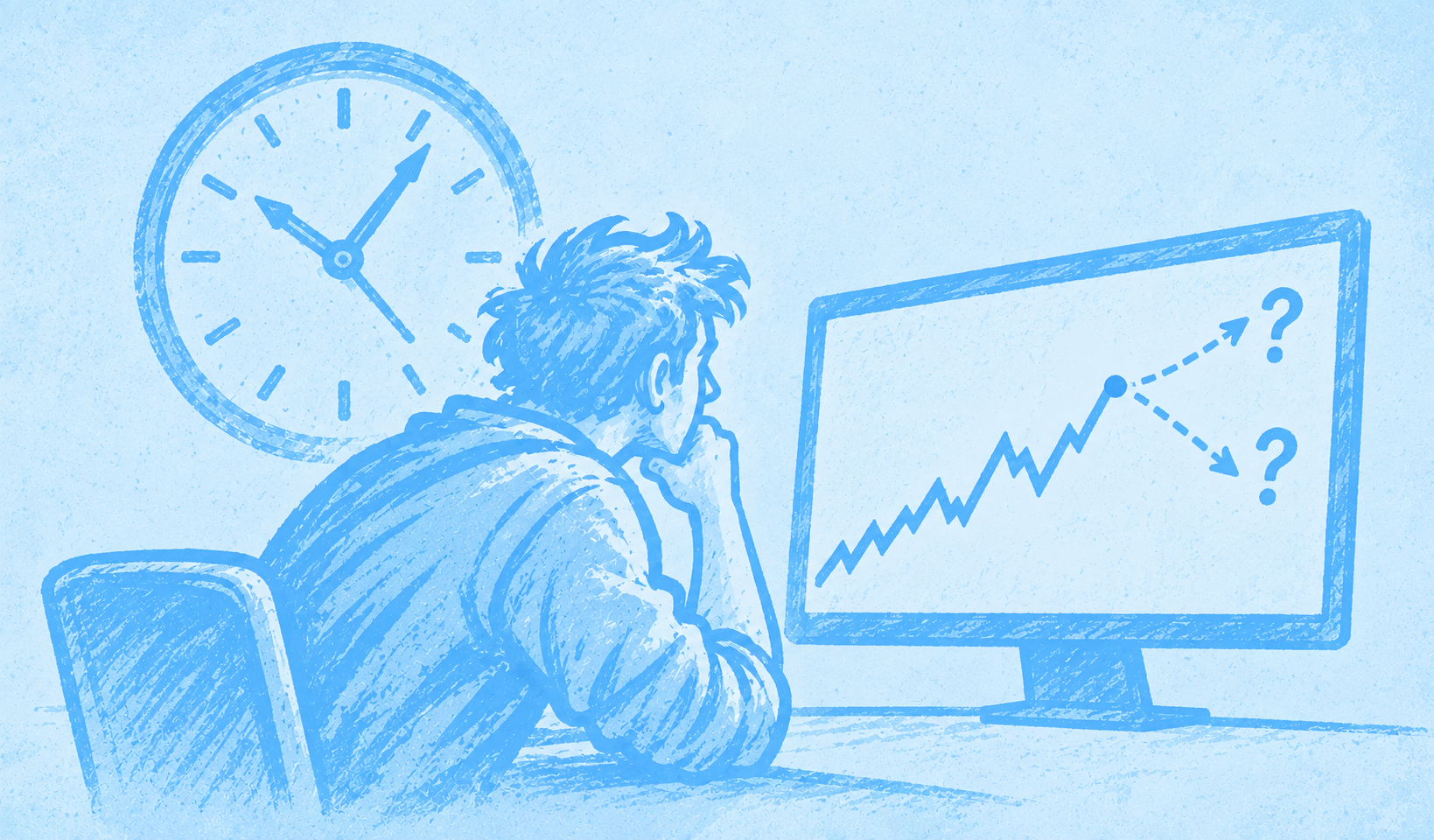
Imagine investing $10,000 in the stock market.
Then the market drops 30% and your account shows $7,000.
You panic: "I can't afford to lose any more."
So you sell.
But then the market recovers and you're sitting on the sidelines with a $3,000 realized loss.
That's one of the hardest parts of investing.
A Decision Can Feel Safe in The Moment and Become EXPENSIVE Later
Since 2000, the S&P 500 has experienced 4 major bear markets:
Dot-com crash: −49%
Financial crisis: −57%
COVID crash: −34%
2022 inflation and rate hikes: −25%
Those weren't small dips.
There were legitimate reasons to be concerned during every one of them.
Yet the broader U.S. market eventually recovered from each one, even if it took some time.
The challenge isn't just knowing that markets have recovered historically.
It's sticking with a long-term plan when everything around you makes you question it.
The Problem With Waiting For Things To Calm Down
Everyone has heard it:
“Time in the market beats timing the market.”
But that's much harder to believe when your portfolio is falling and people on social media are predicting things will get worse.
Selling can feel like the smartest move.
Why not get out now and buy back once things settle down?
Here's the problem: Some of the market's best days arrive when uncertainty is still extremely high.
Think back to 2025.
Despite all the tariff chaos, the S&P 500 finished the year up 16.39%, excluding dividends.
But 3 of its biggest daily gains happened during that uncertain period:
April 9th: +9.52%
May 12th: +3.26%
April 22nd: +2.51%
If you missed only those 3 days while remaining invested the rest of the year, your 16.39% return would have fallen to around 0.40%.
Think about that.
Being invested during those 3 days made an enormous difference.
And there was no reliable way to know in advance when those days would arrive.
People don't sell because they want to lose money.
They sell because waiting feels safer when everything around them looks uncertain.
But once you sell, you have another decision to make:
When do you get back in?
And that can be even harder than deciding when to get out.
Volatility Is The Price of Admission
There's a reason stocks have historically delivered higher long-term returns than cash.
You're taking on real risk.
Businesses face recessions, competition, changing interest rates, and unexpected problems.
Their stock prices can fall significantly, sometimes for years.
And some individual businesses never recover.
Higher returns aren't guaranteed just because you're willing to tolerate volatility.
But if you're investing for the long term, you need to understand that market declines are part of the experience.
The goal isn't to eliminate uncertainty. It's to build a financial system that can handle it.
That means having cash available for emergencies, understanding your investments, and taking an amount of risk you can reasonably live with.
Because the worst time to discover your real risk tolerance is after your portfolio has already fallen 30%.
Understanding What You Own Changes Everything
Imagine buying part of your friend's coffee shop.
You don't know how much money it makes, what it costs to run, or why customers keep coming back.
Then someone offers you 20% less than what you paid for your ownership stake.
You'd probably start worrying.
Did you make a mistake? Does the other person know something you don't?
Now imagine you'd understood the business before buying.
You know it has slow seasons, loyal customers, manageable expenses, and a history of making money.
That lower offer wouldn't automatically make you panic.
You'd first ask whether anything had actually changed about the business.
Understanding what you own gives you something besides the price to base your decisions on. And that applies to index funds too.
What Happens After You Start Investing?
You learn that broad index funds are one of the simplest ways to start building wealth.
That's a great foundation.
But eventually, new questions appear.
Should you add international stocks?
Does owning VOO, VTI, and QQQ actually make your portfolio more diversified?
Should bonds, gold, dividends, REITs, or individual stocks have a place?
And when you have more money to invest, where should it go?
The internet gives you THOUSANDS of answers.
What's harder to find is a framework for deciding which answers apply to your portfolio.
That's why I created Beyond the S&P 500.
It teaches you how to think through what each investment contributes, where your holdings overlap, and whether adding something actually serves your goals.
Because when the market gets shaky, understanding why each investment belongs in your portfolio gives you something to come back to besides the headlines.
If you want to build a long-term portfolio you understand without blindly following what everyone else is doing:
The Beyond the S&P 500 Bundle is $37 through October 31st.
On November 1st, it goes to $47.
– Josh
