
Should You Buy a Home Now or Rent + Invest the Difference?

TL;DR: The Bottom Line
People love to say renting is throwing away money.
But when you buy a home, you're throwing some money away too in the form of interest to the bank, property taxes to the government, and maintenance on the house.
Over a full 30 year mortgage for a $352,480 loan at a 6.55% rate, you’d pay about $453,746 in interest alone.
But that doesn’t mean buying a home is bad.
It means the decision to buy comes down to which living situation fits your life, your timeline, and your local market right now.
Buying tends to win when you plan to stay in the same house long enough (usually 5 to 7+ years), in a good housing market, with a stable financial base already underneath you.
Renting and investing the difference tends to win when you want flexibility and aren't ready (or don't want) to manage owning a home.
For someone who struggles to invest consistently, owning a home can function as a form of forced wealth creation.
The answer to the rent vs own question comes down to running your own numbers in your market.
Anyone who tells you "always buy" or "always rent and invest in stocks instead" is selling you their own conclusion instead of teaching you how to think for yourself.
———
The decision to buy a home or rent isn't as obvious as it sounds if you actually run the numbers.
And the reason is because for the first several years of a 30-year mortgage, the majority of your monthly payment goes toward interest, not paying off the loan.
When you add taxes and maintenance, a homeowner's unrecoverable costs are often higher than a renter's for the first 5 years.
Let me show you what I mean.
The median existing-home sale price in the United States reached $440,600 in June, an all-time high, according to the National Association of Realtors.
As of mid July, the average mortgage rate was 6.55%, per Freddie Mac.
So let's say you put the conventional 20% down on that median home.
That's $88,120 down and a $352,480 loan. Your monthly principal and interest comes out to about $2,240.
Over the first 5 years of owning that home, you'll pay roughly $112,040 in interest and only about $22,331 toward actually paying off your loan.
For every dollar that pays off your home, five go to the bank.
And over the full 30 years? You'll pay about $453,746 in interest alone on a $352,480 loan.
That doesn't mean owning a home is bad, home ownership has many benefits that we'll talk about.
But it also means owning a home isn't always the best decision for every person at every moment of life.
Let me be clear before we go further: I'm not anti-homeownership. I'm pro-ownership of any asset as long as the math makes sense based on where you're currently at in life and what your goals are.
My goal with this newsletter is to give you a more grounded view of homeownership so you can make sure it's the right fit for you right now.
And if it's not, you can still build ownership other ways while you wait for a better time to buy.
It's Not Really a Math Decision (At First)
Many of us grew up hearing versions of "we bought our first house at your age" or "renting is just throwing money away" from our parents.
It's often tied to love, pride, and the story parents tell themselves about their own success.
When that voice activates, the question shifts from "is this financially optimal for me right now?" to "Am I failing to live up to what they achieved at my age?"
Homeownership is one of the biggest symbols of mastering adulthood.
It's a visible display of ownership that many people are proud of, especially when starting a family.
And the last thing many families want to deal with is a landlord who controls what they can do to the house, or when they're forced to move out, or whether their rent jumps next year.
It's also deeply built into our culture.
In Gallup's annual survey, real estate has been Americans' #1 pick for the best long-term investment every single year since 2013.
In the most recent poll, 38% chose real estate, while only 20% picked stocks or mutual funds. (Gallup Economy and Personal Finance survey.)
That preference for real estate over stocks is real and I'm not going to pretend it away with a compound interest calculator.
When I asked my audience on Instagram this question, the answers proved it.
The people who said "buy a home” mostly didn't talk about investment returns.
They talked about their lives: a place for their kids to grow up, a yard to throw the ball in, a place to permanently call home.
One person just said: "I want a house so bad!!"
None of that is about math and that's okay.
A home is a place you live, not just an asset you hold.
But here's where it gets dangerous: when the feeling is the only thing driving a six-figure decision.
Because the feeling doesn't care whether you can actually afford it, whether you'll stay long enough to make it worth it, or whether one broken AC unit will wipe out your savings.
So let's separate the feeling from the finances and look at both honestly.
The Real Cost of Buying: Meet Ryan and Debra
When you factor in property taxes and mortgage interest, sometimes renting a home and investing the difference in the stock market can make more sense, depending on the market you're buying in and current home prices.
So let's actually run it based on recent data from Phoenix, Arizona.
Meet Ryan. He buys a 3-bedroom home in Phoenix at right around the city's typical price of $440,000.
Most first-time buyers aren't putting 20% down in this market, so let's be realistic.
Let’s say Ryan puts 5% down ($22,000) and finances the rest at 6.55%.
Meet Debra. Same city, same kind of 3-bedroom home but she just rents it for about $2,200 a month. Whatever she doesn't spend on the costs of owning, she invests in an S&P 500 index fund.
Now let’s see where they each stand after 5 years.
On Ryan's $418,000 loan, his monthly payment (principal + interest) runs about $2,656.
In his very first month, $2,282 of that payment is interest. Only $374 goes toward the loan.
That's 86% of his payment going straight to the bank's pocket.
Over 5 years, Ryan pays roughly $159,000 in total mortgage payments and only about $26,000 of it actually chips away at what he owes. The other $133,000 is mortgage interest.
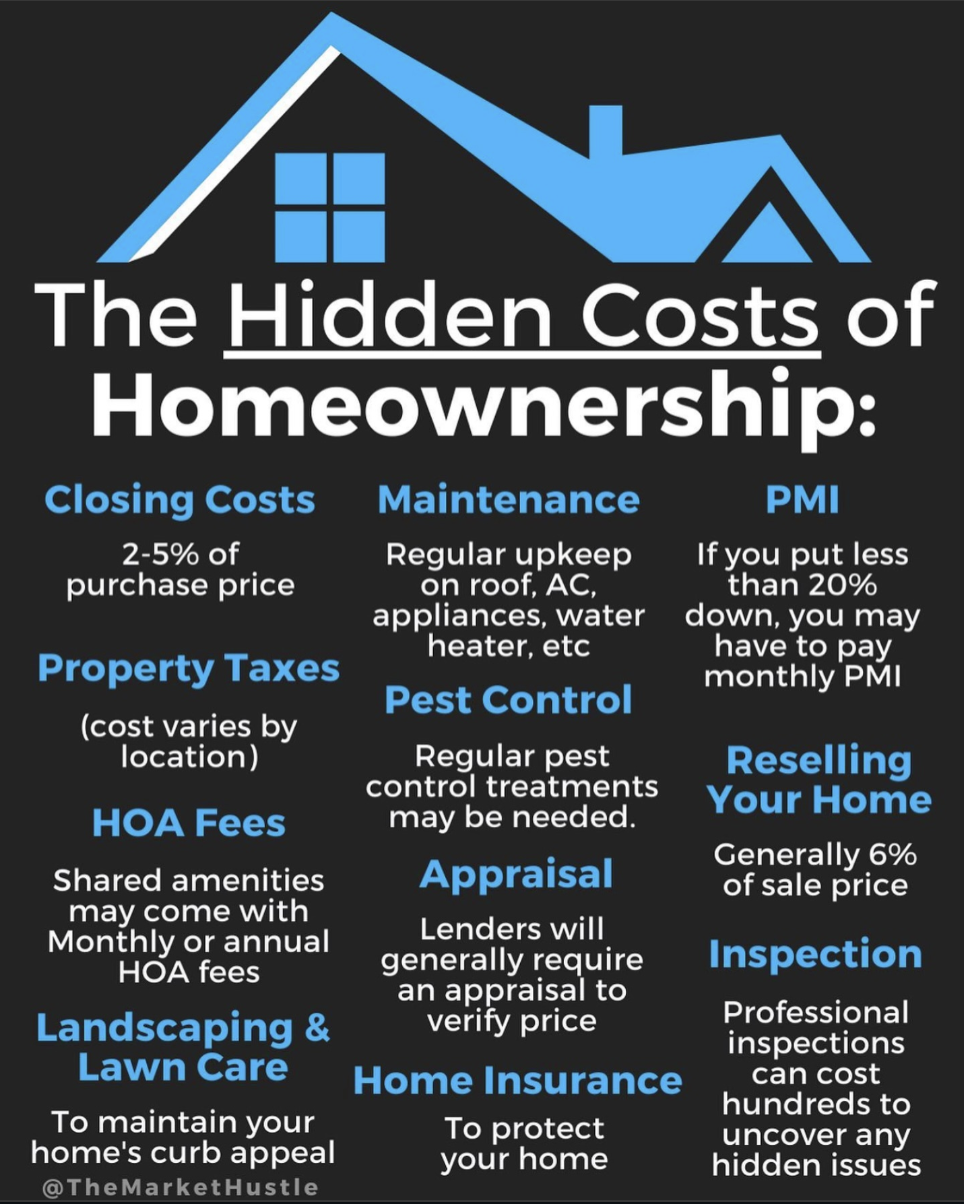
And that's before the costs no one puts on the Zillow listing:
Property tax — Phoenix is actually low here, around 0.5% of value. Roughly $2,200/year or about $11,000 over 5 years.
Homeowner's insurance — around $2,400/year in Phoenix or about $12,000 over 5 years.
PMI — because he put less than 20% down, he's paying this until he hits 20% equity so we’d have to add a few thousand more per year.
Maintenance — the rule of thumb is 1% of the home's value per year and it often runs closer to 2%. Fannie Mae's own guidance says budget 1% to 4%. So let’s call it $22,000–$44,000 over 5 years.
The cost to buy — closing costs run 2–5%, call it about 3% for Ryan since low-down-payment loans carry more lender fees so roughly $13,000 paid on day one.
The cost to sell — For this example, let's assume Ryan's all-in selling costs (realtor commissions, title, escrow, transfer taxes, and concessions) equal about 8%, or roughly $35,000 on a $440,000 sale.
Add up the unrecoverable stuff (interest, taxes, insurance, PMI, maintenance, and the buy/sell fees) and in the first 5 years Ryan has spent well over $200,000.
And here's the part that stings in Phoenix right now: home prices in the metro are actually down about 1.7% over the past year, according to the Case-Shiller index. (Data as of April 2026.)
So Ryan isn't even getting appreciation to offset those costs right now.
He could sell for roughly what he paid, hand $35,000 to agents, and walk away having lost money on the "safe investment" everyone told him to make.
Meanwhile, Debra rents the same house for $2,200 and her costs are just rent. She doesn’t have to deal with roof repairs, property taxes, and has no $35,000 exit fee.
And every month she takes the money Ryan paid into interest, insurance, PMI, and maintenance and feeds it into an index fund.
Five years of investing that difference and Debra's sitting on a portfolio worth tens of thousands of dollars plus it’s liquid money that she can access in a day and she never once had to fix an AC unit in 115 degree heat.
This is the whole trap: buying a home can put you in an immediate financial hole if you’re not prepared.
Using roughly 3% in purchase costs and assuming another 7–9% in total selling costs, Ryan could face around 10%+ in round-trip transaction costs before appreciation has much chance to bail him out.
That's why the rule of thumb holds: if you're not planning to stay put for at least 5 to 7 years, renting and investing the difference is often the better move, especially at today's ~6.5% mortgage rates.
The transaction costs are simply too big to earn back over a short stay.
But Now Let Me Argue the Other Side
If I stopped at Ryan and Debra, I'd be doing the exact thing this newsletter exists to fight against: cherry-picking to win an argument.
I’m not interested in winning an argument for what I prefer to do. I’m interested in helping you understand the different perspectives so you can make a decision that makes sense for you.
So let me build the case for buying to help you see how the math changes if you become a long-term home owner.
We will use the same Ryan buying the same $440,000 home.
But this time he's not moving in 5 years. He's putting down roots for his family. He’s thinking about his kids, schools, a neighborhood he wants to be in for the next 15 years.
For this example, let's assume the Phoenix home appreciates 4% a year instead of the current market dip.
3 forces show up now that barely mattered over 5 years. Over 15, they're enormous.
Force #1: Leverage on the full asset.
This is real estate's superpower and it’s how the big money is made.
Ryan controls a $440,000 asset with about $22,000 down.
When that home appreciates 4% in a year, it gains about $17,600 in value.
But Ryan only put in $22,000.
That's not a 4% return on his money, its closer to an 80% return on his invested downpayment in year one before financing costs, taxes, insurance, maintenance and transaction costs.
Debra earns her 10% on the money she invested in an index fund, but Ryan earns appreciation on the entire house beyond his downpayment.
Force #2: The inflation hedge, the thing I completely left out of the first example.
A fixed-rate mortgage is one of the few major household obligations where your biggest monthly cost gets frozen for 30 years while everything else inflates.
Debra's $2,200 rent isn't frozen. Historically rent rises 3–4% a year, so in 10 years she may be paying around $3,000. In 20 years, maybe around $4,400. Her rent is forever climbing with no ceiling.
Ryan's mortgage payment stays fixed at $2,656 for all 30 years and could be lowered if he refinances into a lower rate down the road.
Once the mortgage is paid off, that monthly mortgage disappears forever, although taxes, insurance and maintenance remain.
Over 5 years that barely registers.
But over 30 years it moves massively in the home owner's favor.
Force #3: The tax-free gain.
When Debra eventually sells her index funds, she owes capital gains tax on the profit.
If Ryan meets the IRS ownership requirements, up to $250,000 of his real estate profit may be tax free, or up to $500,000 for a married couple filing jointly.
There's also the mortgage interest deduction, although it's less valuable since the higher standard deduction took effect in 2018, it's mostly for higher income earners with expensive homes.
Stack those 3 benefits over a long enough hold (leverage on the full asset, a housing cost frozen while rents climb for decades, and a tax-free gain at the end) and buying becomes much more competitive and usually pulls ahead.
The result still depends on appreciation, rent growth, financing costs, maintenance, and whether the renter consistently invests the difference.
But it also gave Ryan something Debra never had: he always knew what his mortgage would cost and no landlord could ever kick him out.
So Which Wins: Renting or Buying?
The honest answer is the one no one selling you a house wants to give: it depends entirely on how long you plan to live in the house and the math on buying in your current real estate market.
For short stays (especially at today's rates, when renting is often cheaper than the true monthly cost of owning) renting and investing the difference tends to win.
But for long stays in a market with steady appreciation, buying usually wins, sometimes by a lot.
Sound familiar? It's the same thing I say about stocks every day: time in the market beats timing the market.
Real estate works exactly the same way. If you buy a home planning to hold it for the next 20+ years, your odds of coming out ahead are strong.
You have time to ride out the dips, the transaction costs get spread thin across decades, home price appreciation compounds, and your payment stays frozen while everyone else's rent climbs.
But if you buy hoping to flip it for a quick profit in a few years? You're basically gambling.
You're betting that appreciation outruns a 10% round-trip in transaction costs on a compressed timeline, in one specific city, with no control over what the market does.
That's the housing version of buying a hot stock or IPO and hoping it pops quickly before your next vacation.
Ownership rewards patience and punishes people in a hurry.
Which is exactly why the timeline question matters more than almost anything else in this decision.
Real Estate vs. Stocks
Most people have a better relationship with investing in real estate than in the stock market.
Owning a property is more tangible. It feels more real to the average person than owning a business they may never see or use.
It's easier to understand the benefits of owning your own home than it is to understand how the stock market or running a business works.
But that doesn't mean buying a home right now is always the best decision you can make with your money at every stage of life.
What's important is buying things that pay you to own them and that can be accomplished in many different ways.
When you buy a stock, you're buying a business.
A business that sells things people want and (ideally) creates profit.
And many of the businesses you buy on the stock market also own real estate.
So in a way, you're getting indirect real estate exposure.
Think about Apple. Their headquarters was valued at over $4 billion when estimated for tax purposes.
And in 2025 alone, Apple spent more than $1 billion buying up office buildings around Silicon Valley. (Per the Mercury News and Santa Clara County records.)
When you own a share of Apple, you own a slice of all of it.
You can also own real estate directly through the stock market with REITs or real estate investment trusts.
These are companies that own and operate income-producing property like apartment complexes, warehouses, or shopping centers.
You buy them just like you would a stock and they're required to pay out most of their taxable income as dividends.
With a REIT you get the real estate exposure and the income with none of the roof repairs or tenant calls.
But you also give up the two things that make owning your own home powerful: the leverage and the fact that you can actually live in it and use the property.
Of course that doesn't mean don't buy a home.
It's that a home is not the only way to invest your money and get rich.
At the end of the day, it's a financial decision you have to make.
If it makes sense mathematically and you can afford to buy a home, then great.
If not, there are other ways to still build wealth and own things beyond just buying a home.
And when you compare the raw numbers without the leverage of real estate, it's not even close.
Over the 20 years ending December 2025, the S&P 500 produced around an 11% annualized total return with dividends reinvested, while the Case-Shiller National Home Price Index appreciated at roughly 3% annually.
On raw asset-price growth, stocks have dramatically outpaced national home appreciation over that period.
But again, real estate's magic comes from using leverage and the value of living in the property.
As one of you put it: "You only put 20% down but you get growth on the full purchase price."
That's a major benefit of real estate and it's the reason real estate builds wealth for people who might never get rich in stocks.
The Human Behavioral Truth
If you've followed The Market Hustle for any amount of time, you know one of my core principles is owning quality assets over long periods of time.
Real estate is the one asset that has that key behavior baked into it.
You can't day trade single family homes.
Selling a home takes months and costs somewhere in the range of 7–9% of the home's value after all of the transaction costs.
So there are forces that incentivize you to hold the house long-term rather than rapidly buying and selling.
Most people aren't glued to daily price charts of their home.
Which is the biggest cause of panic selling in the stock market.
The stock market is more liquid, which has its own benefits. But for most people who don't have an investor mindset, that liquidity can be a curse in disguise.
Real estate forces people to think long-term, especially since you can use the asset and benefit from it today while also building future wealth via home equity.
And that cuts straight to the problem with "rent and invest the difference."
The math only works if you actually invest every dollar of the difference for decades and never touch it.
In the real world, the share of renters who do that is small. Most people spend the difference they may save by renting rather than owning even if they don’t intend to.
Or lifestyle creep eats it via a nicer apartment or home to rent.
So while renting and investing can win on the spreadsheet, buying wins for the average human because the mortgage forces the long-term investing behavior.
Real Estate Isn't Risk-Free
A home feels safer than stocks because you don't see a flashing price on it every day.
But that feeling sometimes hides the real risk.
Remember the power of leverage in Real Estate? It cuts both ways.
If Ryan's $440K home drops 5%, that's a $22,000 loss (roughly his entire down payment wiped out on paper) while he still owes the full mortgage.
That's how people end up upside down: owing more than the house is worth.
And a number of markets are softening right now.
According to April 2026 Case-Shiller data released June 30th:
Denver (−1.8%)
Tampa (−1.8%)
Dallas (−1.6%)
and Phoenix (−1.7%)
were all down compared to a year ago even while the national index stayed slightly positive. (Data as of April 2026.)
Now stack that on top of illiquidity.
If Ryan buys a home and 3 years later his job relocates or life changes and he has to move, he can't just sell in a week.
And if he's upside down, he might not be able to sell at all without writing a check.
Sure, he could rent it out and move. But now he's a long-distance landlord running a business he never signed up for.
Here's how I actually think about it: buying a home is like buying a stock except instead of a stock, you're buying a piece of a community.
You want to understand that community and be comfortable holding your stake in it for the long run. If you're not ready to own it for 5-7+ years, you probably shouldn't buy into it.
The same way you wouldn't buy a stock you only planned to hold for 8 months and then panic when it dips.
And the renter isn't risk-free either, their risk is just not as visible.
Rent climbs with no ceiling. A landlord can sell, not renew, or hike the rent at the worst possible time. And the biggest risk of all: the renter who swears they'll invest the difference in the stock market and then… doesn't.
So it's not "buying is risky, renting is safe." It's 2 different shapes of risk:
Buying: Leverage can work against you, illiquid, higher risk of loss if you sell early.
Renting: Rent climbs long-term with no ceiling, no equity, limited control of the property.
Your job isn't to find the safe option. It's to pick which risk you can handle better in your life right now.
When I asked you all about this on Instagram, one response summed it up better than I ever could: "Math says invest but math doesn't think about risk."
The Part That Actually Decides It: Do You Have a Financial Base?
I came from nothing. If the very first asset I ever bought had been a house, I'd have been in serious trouble.
One broken AC unit or one year where my career wasn't stable yet and I'd have been underwater. I’d be house-rich and cash-poor, one emergency away from losing everything.
I don’t have family who can bail me out if things go sideways.
But if I had $50,000+ in the stock market and 3 months of expenses saved up and then bought a home? It would be a completely different story for me.
That liquid base means when the water heater dies or life throws a curveball, you're fine because you have options to cover yourself.
I ran this by a good friend of mine who works in mortgage lending in Arizona.
His view: If you're in a position where owning makes sense, there are ways to make sure it becomes an asset for you, not a liability. It's the same as the stock market, investing sounds great but done poorly it can absolutely become a liability.
Whether a home ends up your greatest asset or your greatest liability comes down to the execution.
A home is an asset but buying one can still weaken your finances if the debt and maintenance costs exceed what your financial foundation can support.
And this is the trap I’ve seen many people fall into: buying a home as their very first real asset with nothing liquid behind it.
People whose entire net worth is locked in a house they can't spend.
As one of you put it: you can't live in the S&P 500 but you can't retire off your primary home either.
The best answer is both but you need the financial base first.
That's why my take for most people and at most life stages is this: build a liquid asset base first before you buy the home.
Not because renting is "better." Because a home bought on top of a solid financial foundation is an asset.
And a home bought on top of nothing is a liability waiting for its first emergency.
How to Actually Decide
I'm pro-ownership of any asset as long as the math makes sense based on where you're currently at in life and what your goals are.
But if you run the math and decide renting makes sense for the next few years before you consider buying, that doesn't mean giving up on owning things.
Here's the framework I use:
1. The timeline test: If you’re planning to live somewhere for under 5 years, renting almost always wins. The transaction costs are almost always too big to earn back in a short time frame. But if you think you’ll stay 7–10+ years in a good housing market, buying a home starts to take over. This is the single biggest variable.
2. The 5% rule and why its assumptions matter: There’s a famous shortcut for comparing renting and buying called the 5% rule made famous by Ben Felix.
You take the price of the home, multiply it by 5%, and divide by 12.
That gives you a rough estimate of the monthly unrecoverable cost of owning it.
On our $440,000 Phoenix home, the rule gives us:
$440,000 × 5% ÷ 12 = about $1,833 per month.
Since Debra is paying $2,200 in rent, the traditional 5% rule would make buying look more attractive.
But the 5% rule is only a shortcut and every shortcut has assumptions underneath it.
The original 5% roughly accounts for 3 costs:
Property taxes: around 1% of the home’s value each year.
Maintenance: around 1% per year for the water heater, roof, AC, plumbing, appliances, and all the smaller repairs that come with owning a home.
Cost of capital: around 3% for the interest paid on the mortgage and the returns your down payment could have earned somewhere else.
That last part matters because every dollar has a job.
Money used for a down payment cannot also be invested in the stock market.
But the down payment is not earning nothing either. It is tied to a home that may appreciate over time.
So for this comparison, the opportunity cost is the difference between what the money might earn in stocks and what it might earn through home appreciation.
Let’s update the assumptions using today’s numbers:
Ryan puts 20% down, which is $88,000, and borrows the remaining $352,000 at 6.55%.
During the first year, his estimated unrecoverable costs would look something like this:
Mortgage interest: approximately $22,900.
Property taxes: approximately $2,200, using Phoenix’s roughly 0.5% effective rate.
Maintenance: approximately $4,400, using the common rule of thumb of 1% of the home’s value each year.
Opportunity cost of the down payment: If we assume stocks return 7% and the home appreciates 3%, the difference is 4%. Applied to the $88,000 down payment, that is approximately $3,500.
Add everything together and Ryan’s estimated unrecoverable costs come to roughly $33,000 during the first year, or about $2,750 per month.
Compared with Debra’s $2,200 rent, renting is approximately $550 per month cheaper under these assumptions.
That does not automatically make renting the better decision.
Change the mortgage rate, home price, property taxes, maintenance costs, expected investment returns, appreciation, or how long you plan to stay, and the answer changes too. That’s the entire lesson.
The 5% rule can point you in the right direction but it should not make a six-figure decision for you. Run the numbers using your actual market and the assumptions you can reasonably defend.
3. The community test: Do you actually want to own a stake in this specific community for the long term? If you can't see yourself holding a piece of ownership in your community for 5-7+ years, treat it like a stock you're not ready to buy.
4. The financial base test: Do you have a liquid financial foundation underneath you (emergency fund plus liquid assets like stocks) so a roof repair or a job layoff doesn't financially bankrupt you? If not, that comes first whether you rent or buy.
5. The honesty test (for renters): If your plan is "rent and invest the difference," are you actually going to invest it? Every month? Automatically? Because if that money turns into a nicer apartment and more DoorDash orders, the whole math collapses and you'd have been better off with a mortgage forcing the savings.
One more idea worth sitting with because a bunch of you brought it up and it flips the whole question.
Renting and investing isn't necessarily choosing stocks over real estate forever.
For a lot of people it's choosing real estate later so they can afford a better home.
One reader put it bluntly: If he invests the money he'd have spent on one house in the stock market, in 5-10 years he could buy several more homes.
Others were a fan of investing in the stock market now and renting to skip the starter home and buy your dream home in 10 years instead of buying a place you'll outgrow in 5 years and eating 8–10% in selling costs to trade up.
And then there's the angle almost no one connects to housing at all: your portfolio is what determines when you get to stop working.
As one person I talked to put it: rent and invest first so you can retire earlier because your portfolio decides your retirement timeline, not the house you own.
So the choice isn't always "buy a house now or focus on stocks."
Sometimes it's "starter house now or invest in stocks now and buy a bigger house later."
What I Actually Do
One of my 5-year goals is to buy my own home.
I waited a bit because I was focused on building my business and was moving around cities a lot in my 20s.
But that doesn't mean I didn't build wealth.
I just focused on investing in stocks and my business first.
And the cool part is I can skip the starter house phase because I now have more financial resources to put a bigger down payment down.
At this stage of my life, the flexibility and the stock market compounding matter more to me than locking into one place and I want a real foundation under me before I take on a house.
When I do buy, I want it to be an asset sitting on top of a solid base I already have. Not the thing my entire financial life is dependent on.
If you're renting and investing the difference, the whole strategy lives or dies on one thing: actually investing the difference.
That's the hard part. Not knowing you should but actually doing it.
And that's true whichever side of this you land on. Buy or rent, the financial base has to get built.
Which is the part most people put off.
That's why I built Money Mastery.
It's my step-by-step program for building your own long-term investing system: the accounts, the strategy, and the automation that makes the money move every month whether you feel like it or not.
Because a mortgage builds wealth for one simple reason: it forces the behavior.
Money Mastery is how you build that same force into stock market investing.
Whether you're renting and investing the difference or building your financial base before you buy, this is how you make sure the wealth-building actually happens.
The Bottom Line
The real question was never rent vs. buy a home.
The question is: which cost and risks fit your life, your timeline, and your local market and do you have a foundation solid enough that whichever you choose becomes an asset instead of a liability?
Run your own numbers and build your financial base first.
And don't let anyone hand you their conclusion when what you actually need is a way to think it through for yourself.
Whether you rent or buy, the winning move is the same: buy things that pay you to own them and make sure you can actually hold them long enough to benefit.
— Josh
The Market Hustle is for educational purposes only and is not financial, tax, or legal advice. All figures are estimates based on sources and data available as of July 2026 and will change over time. Do your own research and run your own numbers before making any major financial decision.
