TL;DR — The Bottom Line
The S&P 500 has averaged ~10% annual returns since 1957 by continuously replacing failing companies with new winners.
Even investing at all-time highs has historically delivered strong long-term results. The key forces driving growth (business expansion, technology innovation, and economic growth) remain intact in 2026, though AI spending concentration and a weakening dollar are real risks to watch.
———
You hear the advice everywhere: "Just keep investing, markets go up long term.”
But on the surface, that advice can feel naive, especially when the markets are hitting new highs.
The last thing you want to do as an investor is buy a stock at its highest price right before it falls.
And right now, that concern is especially loud.
The S&P 500 has hit new all-time highs around 23 times in 2026 alone.
The index has pushed well past the 7,000 level, riding a massive wave driven heavily by the AI and tech rally.
So naturally, when markets keep hitting new all-time highs, a lot of people pause and ask themselves if the show can keep going.
Is this stock market growth sustainable?
Is the market overvalued right now?
Is it better to wait for the next crash before you invest?
This newsletter aims to answer those questions and help you understand why legendary investors like Warren Buffett tell most people to just buy the S&P 500 and call it a day.
For the sake of this piece, I'm going to focus solely on the S&P 500 since it's the most widely watched and invested-in index in the world.
But the concepts apply to any broad market index.
To answer whether you should keep investing at all-time highs, you first have to understand what actually keeps the stock market going up.
So this newsletter breaks down the mechanics of why the stock market goes up over time.
Why the Stock Market Goes Up Over Time: The Track Record
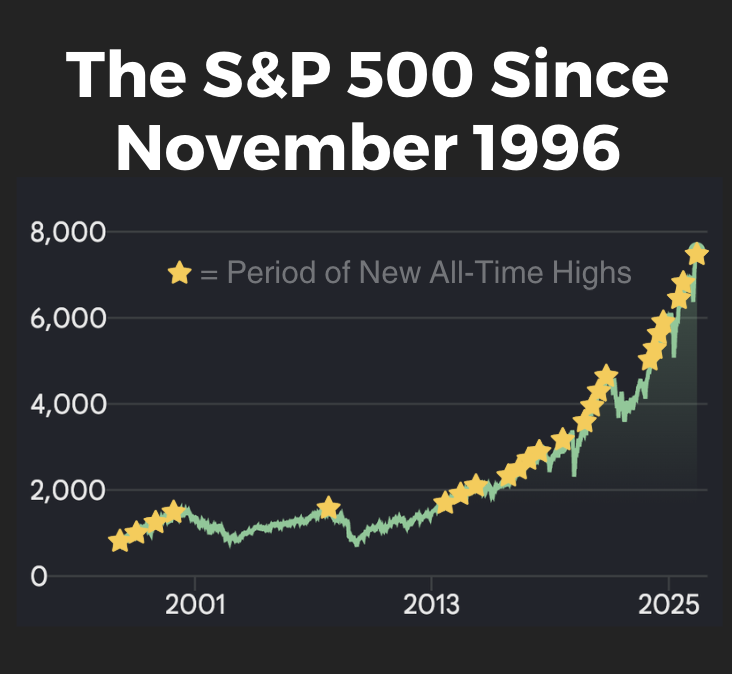
The stock market trading at or near highs isn't uncommon.
According to Bespoke Investment Group, the S&P 500 has spent 44% of its trading days within 5% of an all-time high since 1952.
And since 1980, the index has grown by roughly 18,160% (a 182-fold increase), which works out to an average compound annual growth rate of about 11.92% with dividends reinvested.
The index has been a growth machine for decades.
Of course, hearing that, your first thought is probably: "Sounds cool Josh but I can't go back to 1980 and invest."
But when you actually understand how the S&P 500 works beyond the "just buy the S&P 500, it holds 500 stocks" advice that's plastered all over social media, you can understand what drove that growth and what we might reasonably expect over the next few decades.
What You're Actually Buying
When most people buy a stock, they don't look beyond the price chart they see on Robinhood.
Which is the same as investing blindfolded.
When you buy a stock, you're buying a piece of ownership in a business that generates profit by providing value people are willing to pay for.
You're buying a portion of the future profits they create.
The more profit a company is expected to create, the more valuable its stock becomes.
So if you understand what drives the stock price behind the scenes, you naturally have an edge over people who are only focused on today’s stock price and just chasing what's going up or panic selling what's going down.
This applies to index funds like the S&P 500 too.
It's easy to tell someone to buy the S&P 500 and call it a day.
But if they don't understand what the S&P 500 is, how it works, and what causes it to grow long term, they'll be the first to panic sell or stop investing when the market drops since they’re only focused on the stock price and don’t understand anything beyond that.
Most people know the S&P 500 is a list of the 500 biggest U.S. stocks.
What many don't know is that the list is constantly changing.
If a company starts to massively fumble, it gets booted out and replaced by the S&P 500.
It's not a stagnant list and it officially rebalances four times a year.
To become an S&P 500-worthy company, a business has to meet some requirements set by S&P. A few of the main ones:
Be profitable over the last 12 months
Be worth at least $22.7 billion
Be listed on a U.S. stock exchange
Have been trading publicly for at least 12 months
Since 1957, only 53 of the original 500 companies are still on the list today.
And even though companies come and go, the S&P 500 has still averaged right around a 10% annual return since then.
The S&P 500 naturally weeds out failing companies and replaces them with the economy's better winners, making it self-cleansing.
For example, back in 1990 tech made up only about 6% of the S&P 500.
Today, tech companies make up closer to 38% of it.
The reason is simple: tech companies have been the ones posting the biggest results and generating the highest profits over the last few decades.
So in short, the S&P 500 filters for the biggest and most profitable public U.S. companies.
These are companies with the best talent, the most resources, and the best ability to absorb shocks that would typically wipe out smaller companies.
For that reason, the S&P 500 is essentially a bet on the growth of the American economy.
What Causes The Stock Market to Grow Over the Long Term
Now let's talk about what actually causes the S&P 500 to grow.
The S&P 500 grows when the companies inside it grow.
And those companies grow in a few different ways.
Business Growth and Expansion
Companies are profit-seeking machines.
They're constantly looking for new ways to expand, reinvest profits, offer new services, or improve the services they already offer to keep more of their profits.
For example, Nvidia made $4.68 billion in revenue in their 2015 fiscal year. By their 2025 fiscal year, that number was over $130 billion.
That’s thanks to the way the business reinvested in its growth and expansion over those 10 years.
Technology Breakthroughs and Innovation
Technological breakthroughs that make people more productive expand the pie for everyone.
The printing press spread ideas faster than anyone thought possible.
Then someone built the steam engine.
Then the railroads to move supplies across a continent.
The telegraph let a message cross that same distance in seconds.
Then we invented electricity.
Mass production made it possible to build more for less.
Then computers and the internet rewired how everything works.
And now we're entering the AI era.
Each technology breakthrough made the people and businesses who lived after them more productive than before.
35 years ago, very few companies used computers.
Most ran on paper, filing cabinets, and mail rooms to operate.
It was way less efficient and more costly than how businesses operate today thanks to computers.
The more efficient a company gets, the more it can build and the more profit it keeps.
AI is the new breakthrough.
It's still in the early stages but it's clear it'll be a game changer.
How exactly it unfolds is still up in the air.
AI has the potential to turn average employees into superstars and superstars into one-person businesses.
And companies know that too. Which is why they’re investing heavily into AI.
Microsoft (MSFT), Alphabet (GOOGL, GOOG), Amazon (AMZN), and Meta (META) are on track to spend somewhere in the range of $650–$700 billion on AI investments in 2026 alone, based on their own guidance.
This has made some investors nervous because they’re questioning if these companies will get a return from AI that justifies all of this big AI spending. More on that later.
Economic Growth
The more the economy expands (new jobs, more options to buy and sell, a rising standard of living) the more money people have to spend.
That creates a cascading effect in the growth direction.
The S&P 500 companies of today are completely different from the companies decades ago.
And over the last 20 years, the U.S. economy has grown significantly, expanding from a GDP of around $13 trillion in 2006 to over $30 trillion today, according to government data.
What Causes The Stock Market to Decline
Now, of course, the stock market doesn't just go up in a perfectly straight line.
Stock market crashes are a normal part of the long-term growth cycle.
Let's talk about a few of the main causes.
Systemic Shocks
The economic machine is incredibly resilient but there are still moments when certain events freeze the system and business growth across the board.
COVID-19 was one recent example.
Businesses were forced to shut down for weeks. Profits declined across the entire economy. Because of that, the stock market started to re-adjust what it thought businesses were capable of earning in the future.
Another example is the 2008 financial crisis, oil and energy shocks, and the complete collapse of industries.
These types of events happen and similar ones will keep happening.
And when they do, they tend to be a step backward that makes it harder for businesses to operate and grow.
This is why as an investor, you ideally want to invest in companies that have a track record of surviving bad business environments, not just the good times.
Ask yourself this: Do you believe the companies you invest your money into can survive when money gets tight and the economy stalls or contracts?
Company Valuations Get Ahead of Reality
Everyone's a genius when the stock market's going up.
The problem starts when greed takes over and the market essentially gets drunk and throws money at anything that moves.
Market manias happen when people get caught up in the greed cycle or have a fear of missing out on stock gains without caring about the price they're paying.
Think of it like dating. When you meet someone new that you like, you might build a vision of who you think they are.
But as you get closer, reality becomes harder to ignore, and sometimes the image you had doesn't match who they actually are.
The internet and software turned out to be one of the biggest breakthroughs of the last century. We know that now.
But knowing the technology had real potential didn't save investors who got ahead of themselves buying shares of companies like Pets.com that made no profit in the 1990s.
This led to a massive stock bubble in the late 1990s and priced in growth that took years longer to actually show up.
The dot-com crash wiped out trillions, even though the internet itself went on to change everything. Most of those internet companies failed and went bankrupt.
But a few survived and came out the other side stronger like Amazon, Apple, and Adobe.
AI could rhyme with that. The technology being real and the stocks being fairly priced are two completely different questions.
That being said, many of today's AI leaders are on a different playing field than the unprofitable tech startups of the 1990s.
They're real businesses making real money.
And investors are more cautious now, still carrying the scar the dot-com bubble left behind.
Economic Declines
If the economy slows down or shrinks, companies start doing layoffs to save cash and adapt to the slower economy.
Those laid-off employees then have less money to spend, so they start hoarding cash.
That leads to a compounding negative feedback loop that ripples across businesses and households.
People spend less, businesses earn less, and because everyone's spending less, businesses grow less.
Because businesses grow less, stocks grow less or decline.
And because people's retirements and investments are shrinking, they spend even less.
Predicting these events or how long they’ll last is very difficult.
You could be right about the event that causes the next decline and still be wrong on timing.
The market might take longer to catch on or the upsides of the business developments might offset the downsides and still result in stock growth.
The way the stock market will move in the short-term is very hard to predict.
Even if you’re right on certain events unfolding, the market could still shrug it off due to other variables.
At the end of the day, you want to own companies built to survive tough times, not companies that are only good to own when times are good.
Everything we've covered so far is history: how the S&P 500 has actually behaved through decades of booms, crashes, and recoveries. History is the best guide we've got.
But it's a guide, not a guarantee.
So let's shift from what has happened to what might.
The Bull Case for the Next Decade
Here's how things are shaping up for the next decade, based on what we can see in 2026.
AI Productivity Boost
AI is going to change how business is done forever.
The AI we have today is its worst version it will ever be.
Ten years from now, odds are it'll be far better.
It’s already much better than it was even 6 months ago.
Companies are still actively trying to find ways to implement and integrate it.
Some are having success, some aren't.
It's very much the wild west right now but the expected long-term productivity boost is huge.
AI has the potential to shift how we work and how business is done in general, much like the internet did.
Companies are putting real money behind it to build out this next chapter.
Here’s the signal that got my attention recently:
Warren Buffett’s Berkshire Hathaway took a new $10 billion stake in Alphabet (Google).
If you know anything about Buffett, you know this is not a classic Warren Buffett move.
He avoided most tech for decades because it sat outside his circle of competence.
Apple was the rare exception.
Now Greg Abel (Buffett's new replacement) is making Google a top-5 Berkshire holding. That's a big shift.
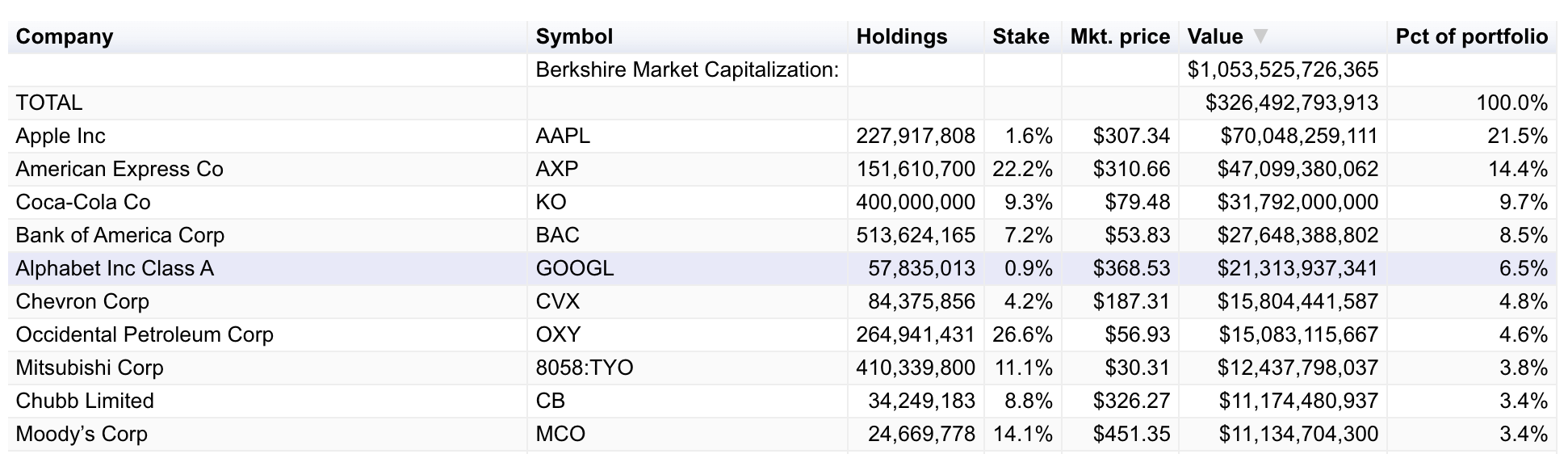
Source: CNBC Berkshire Hathaway's Holdings
And Berkshire didn't just buy shares off the open market.
Per Alphabet's own filings, Google raised the cash through a new stock sale, which means Berkshire's check goes straight toward funding Google's AI buildout.
Google is expected to spend $180 billion+ on AI alone in 2026 based on its latest guidance.
For Berkshire to commit $10 billion to that, Greg has to believe AI isn't a bubble.
Warren Buffett is still advising Greg so Buffett also has to see the logic in the cash deployment.
That's about the most bullish AI signal Berkshire could send.
The Innovation Engine
The U.S. is known as an innovation economy.
It's why the country leans so heavily into tech, innovation, and entrepreneurship.
It gives the U.S. an advantage both economically and militarily.
The internet itself was developed back in the late 1960s by a research agency of the U.S. Department of Defense.
Microsoft designed the software ecosystem that businesses around the world still run on today.
And the current AI boom was kicked off by OpenAI, with Nvidia building the chips powering nearly all of it. All American companies.
Will the U.S. be the center of innovation forever? Probably not.
But at the time of this writing in 2026, it still is.
Global Operating Companies
The global economy looks very different than it did decades ago.
Most big companies now operate all around the world, not just in their home country.
That includes the biggest U.S. companies.
By FactSet's numbers, around 41% of S&P 500 revenue comes from outside the U.S. and that share has been climbing.
That means America's biggest companies aren't betting on the U.S. economy alone.
When one region slows down, another can pick up the slack.
The more these businesses expand abroad, the more room they have to diversify their business and keep growing.
The U.S. stock market is still in a league of its own. It currently sits at a market cap of around $75.7 trillion.
The next biggest, China, is around $10.9 trillion.
That’s why investors from all over the world flock to the U.S. and IPO here to raise money.
Will that be the case forever? Probably not.
But it’s still the case in 2026 and that's worth noting as an investor.
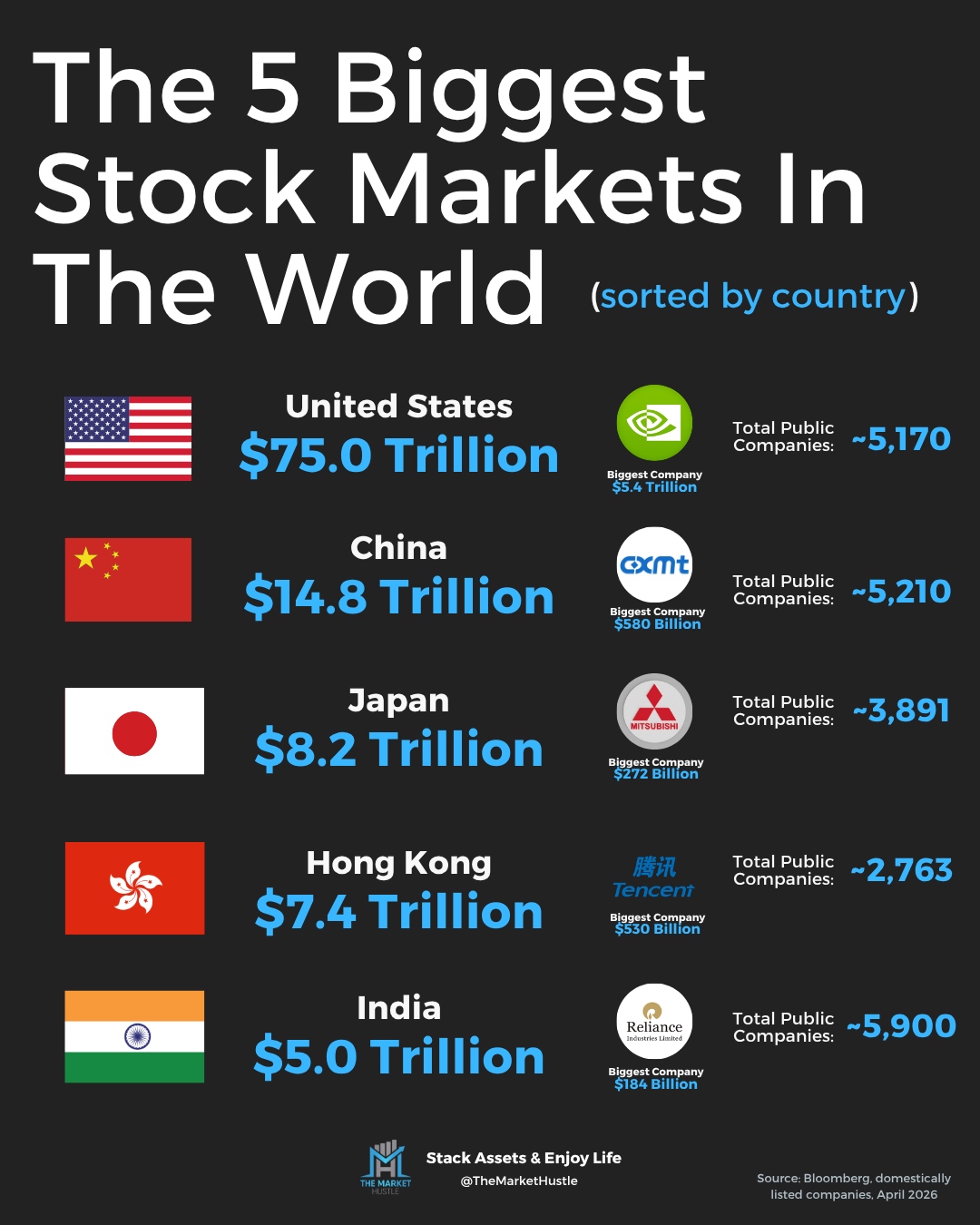
Data as of May 18th 2026
The Bear Case for the Next Decade
Nothing in the stock market is ever guaranteed.
And if I only gave you the bull case, I'd be doing the exact thing this newsletter exists to push back against.
So here are the real risks to consider.
The AI Bet Might Not Pay Off (at least not as expected)
This is the big one and it's worth sitting with because it's the flip side of the bull case I just made.
The bear case for AI isn't that the technology doesn't work.
It's that the trillions being poured into it might not deliver the returns the market is already expecting.
The Big Four tech companies are on track to spend close to $700 billion on AI infrastructure in 2026 alone.
But AI revenue is a fraction of that right now, and a widely cited MIT study found that around 95% of companies with AI projects haven't seen any measurable impact on their bottom line so far.
Some of the spending also looks circular where AI companies and infrastructure giants invest in each other, which can inflate the appearance of growth without real-world demand showing up underneath it.
Here’s the current tension in plain terms: the market is betting AI delivers a massive payoff.
If that payoff arrives late or smaller than expected, you could see a painful reset in exactly the names driving this rally.
The market's already twitchy about it, some of the biggest spenders have taken sharp hits this year the moment investors got nervous about the higher AI spending.
A Market This Concentrated Cuts Both Ways
The same handful of mega-cap tech names driving these gains also means the index is more top-heavy than it's been in decades.
The largest 10 companies now make up nearly 40% of the entire S&P 500.
You're still holding 500 companies but a huge chunk of your money is really riding on a small cluster of tech giants, most of them tied to the same AI bet.
When a few companies carry that much weight, their stumble becomes everyone's stumble.
The thing powering the climb is the same thing that could amplify a fall.
If the AI trade reverses sharply, you don't just lose the leaders. You also lose the outsized influence they have over the whole index.
Now, here's the other side, and it's the same point I keep coming back to: this isn't the first time the index has been top-heavy.
In the late '90s it was tech.
Before that, other giants.
The S&P 500 has always eventually rebalanced.
The bloated leaders shrink or get replaced if they don't post results and new winners take their place.
Concentration is a real short-term risk but it's not usually a permanent one.
If this section made you look at your own portfolio differently, that’s what I wrote Beyond the S&P 500 for. It walks through how diversification actually works, what “top-heavy” means for the index funds you already own, and a simple way to think about what else, if anything, belongs next to them.
A Less Powerful Dollar
The U.S. has a privilege almost no other country has: because the dollar is the world's reserve currency, America can borrow at favorable rates and run deficits that would sink most other economies.
The whole system runs on the world's trust in the dollar.
But that trust has been wobbling.
The dollar has weakened and more countries have started building ways to trade around it, settling deals in other currencies and holding less of their reserves in dollars.
None of this topples the dollar overnight but it chips away slowly at an advantage the U.S. has leaned on for decades.
Here's the nuance though because it doesn't all cut one way: a weaker dollar actually helps a lot of S&P 500 companies in the short run.
Since so much of their revenue comes from overseas, a cheaper dollar makes those foreign earnings worth more when they're converted back home.
So the real risk here isn't a sudden hit to your portfolio, it's the slow decline of the structural edge that's made the U.S. the safest place in the world to park money.
And that edge is a big part of why the U.S. market has commanded such a premium.
But let’s go back to what we covered earlier... The S&P 500 is self-cleansing.
If the AI investment disappoints and today's business leaders fumble, the index does what it's always done: it boots the losers and replaces them with whatever's actually working next.
That’s a big contributor to its long-term growth track record.
The index itself has survived in many different bleak scenarios: 1970s inflation, the 2000 dot-com bust, 2008 great financial crisis, and COVID-19 each time by adapting.
You're not betting AI specifically pays off. You're betting that American business keeps finding its next engine of growth.
And if these risks still worry you, that's fair. That’s where diversification comes into play.
There are ways to address them, like adding exposure to companies outside the United States, non-tech companies, or even smaller companies.
Every investment has risks though. Nothing is ever guaranteed.
But at the end of the day the biggest risk is never taking any risk.
Meet The Unluckiest Investor Alive
Let’s call him Bob. Bob has a gift for buying at exactly the wrong moment.
He puts $10,000 into the S&P 500 right before the dot-com crash in 2000.
Then another $10,000 right before the 2008 financial crisis.
Another right before COVID hit in 2020.
And one more right before the 2022 downturn.
Four separate buys at $40,000 total, every dollar of it invested at a peak right before the floor fell out and he never bought a thing in between.
So where would that $40,000 be today? Over $138,000.
That's a 245% total return despite being the worst-timed investor.
It's actually dragged down by the 2020 and 2022 buys that haven't had much time to grow yet.
The money that went in before the 2000 and 2008 crashes turned into roughly $50,000 per $10,000.
If Bob had kept buying during the declines (when stocks were essentially on sale) he’d be up significantly more.
Think about what he lived through… Multiple crashes, two recessions, geopolitical shocks, and a global pandemic.
The worst entry timing of the last 26 years.
And by simply holding through all of it, he still nearly 3.5x'd his money.
The lesson is that the structural forces of growth (innovation, productivity, an expanding global economy) overwhelm even the worst entry timing over a long enough horizon.
(Quick note on the math: that's a price-only estimate that doesn't even count dividends. Add those back in and the number is meaningfully higher.)
Here's the same lesson in its simplest form: One $100K buy at the 2008 peak, never touched again:
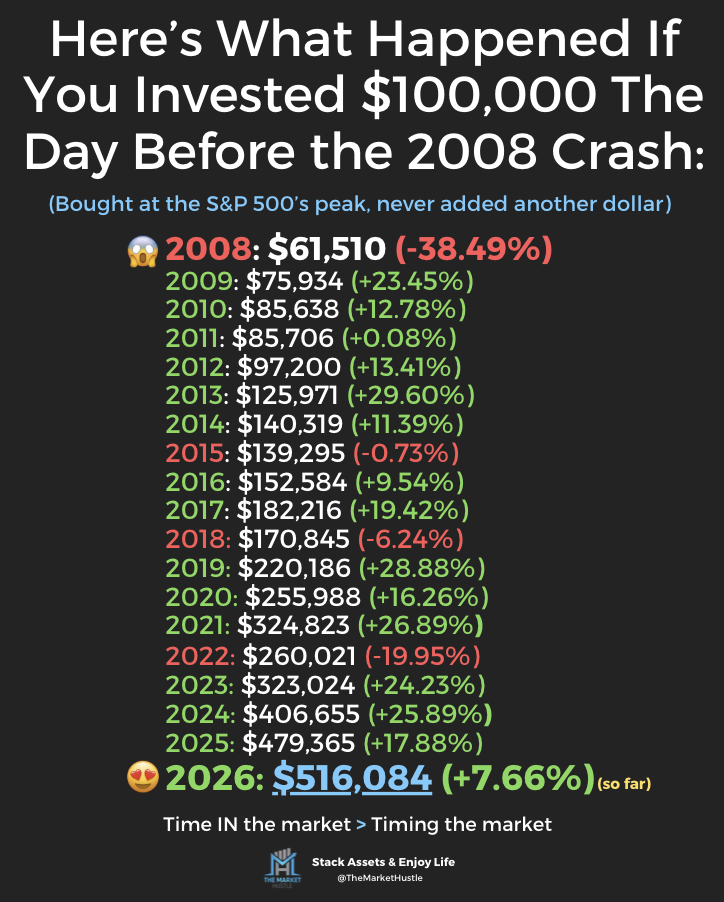
Data as of June 5th 2026
What This Means for You As An Investor
So we know how the market grows over the long term.
The structural forces are real and over a 5+ year horizon they tend to overwhelm the short-term noise.
But knowing the market goes up long term doesn't mean you can't still wreck yourself in a bull market.
Your portfolio is likely up right now.
Your coworker keeps bragging about his new trades.
Your group chat is full of "should I buy this stock?" screenshots.
Bull markets feel amazing in the moment.
They're also where most investors destroy years of compounding.
Here's how it happens:
Confusing Luck With Skill
When everything goes up, everyone feels like a stock-picking genius.
They forget a rising tide lifts all boats.
Then they bet bigger on "their" ability right before the tide goes out.
If your strategy only works in green markets, it isn't a strategy. It's gambling.
Chasing What Already Went Up
People buy what's up 200% instead of what actually makes sense.
By the time a stock is trending on social media, the easy gains are usually gone.
Ask yourself this: if you bought a stock today and it fell 30% tomorrow, would you want to buy more?
If not, don't touch it.
Letting Speculation Become Your Strategy
You started with 90% index funds and 10% "fun money."
12 months later it's flipped.
The fun money grew, so you stopped contributing to the boring stuff.
Now half your portfolio is in stocks you found on Reddit and barely understand.
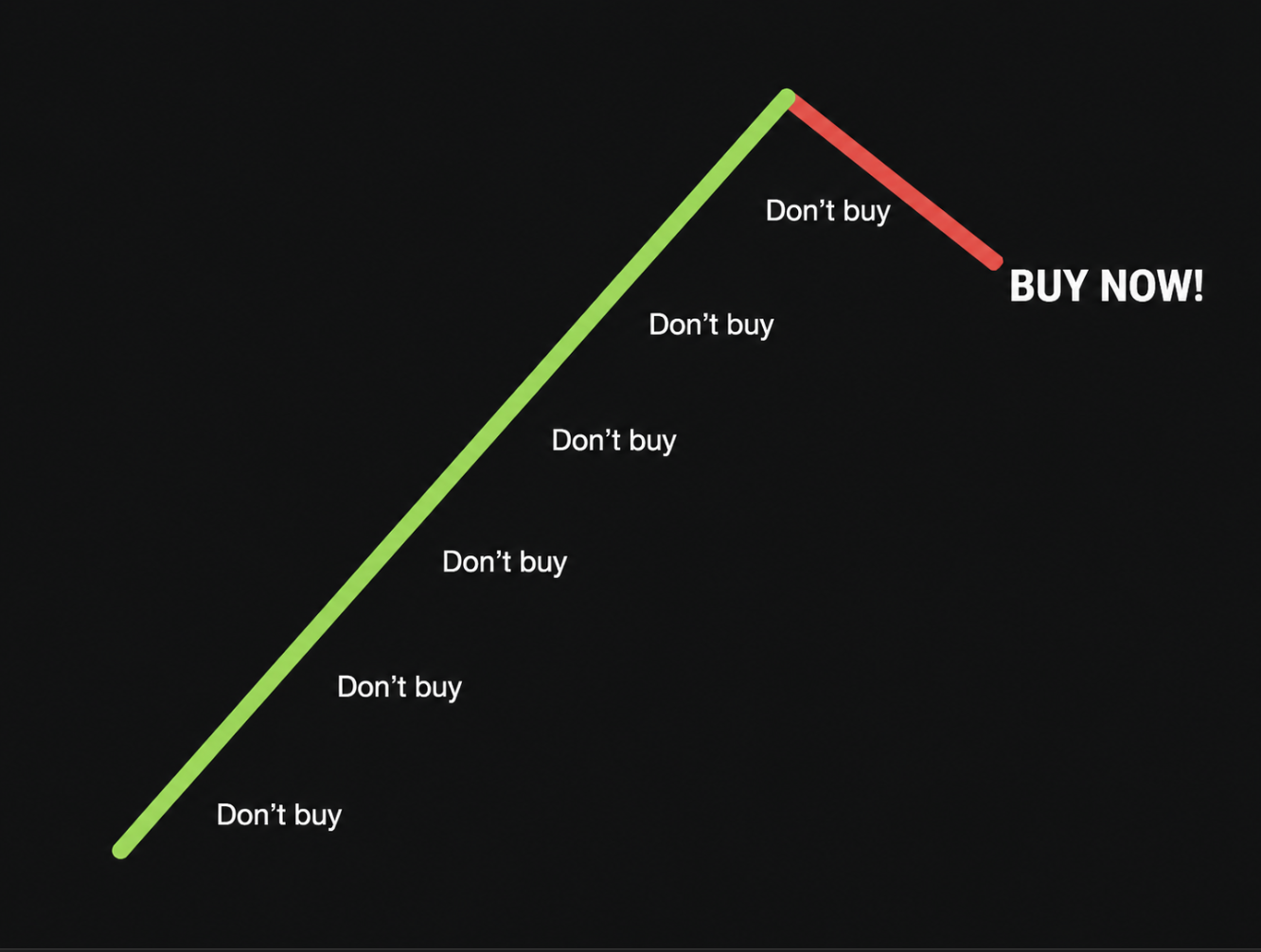
Stopping Investing To "Wait For a Dip."
People sit in cash waiting for a pullback that doesn't come.
Months of compounding lost.
And when the dip finally arrives, it's often higher than where they originally paused.
If you're investing for the next 10+ years: dollar-cost averaging beats predicting the top.
Taking on Leverage
Margin, options, "it always goes up so why not borrow."
Leverage feels amazing when markets are climbing.
Then it blows up your portfolio the moment the market reverses.
Most people who lose everything in a crash lose because of the greedy bets they made before it.
Believing The Music Won’t Stop
If you can't picture yourself losing 30% of your portfolio without panicking, you're not invested. You're gambling.
Bull markets create amateur investors who think they're geniuses.
Then the turn comes and reveals who actually had a system.
Don't wait for the crash to find out which one you are.
“But it feels overpriced..."
And if you're sitting there thinking "but it feels overpriced", I get it.
This is the trap that catches almost everyone.
You look at the market, decide it's too high, and wait.
Then it climbs higher.
Now you're not just worried it's overpriced, you're also kicking yourself for not buying earlier.
So you freeze somewhere between "I missed it" and "I can't buy now."
That whiplash is the exact feeling that keeps people on the sidelines for years.
That feeling never fully goes away.
Buying when the market's at a high will always feel uncomfortable.
The goal was never to win the "is it overpriced?" argument in your head.
The goal is to build a system that focuses on the long-term and makes the question irrelevant by investing on schedule, in bull markets and bear markets and let time do the part your emotions can't.
The simplest way to do that is by dollar cost averaging, making investing a habit.
If the market keeps going up, your earlier buys benefit.
If the markets start to go down, you continue to add more shares of ownership at a cheaper price bringing down your average price paid.
What I Actually Do in This Market
When I first started investing, I thought I had to chase whatever was going up just to keep up.
I've since made far more money sticking to my system than I ever did trying to time the market.
And I've watched most people do the opposite: chase the hype and end up making decisions they regret months later.
So here's what my system actually looks like.
The majority of my money is dollar-cost averaged into boring ETFs, where I'm playing the compounding game.
I don't need that money for 10+ years so I'm comfortable continuing to stack ownership.
Dollar-cost averaging smooths out the ebbs and flows of the market.
It focuses on getting your money in over the long run so you actually benefit from compounding without having to predict or time anything.
I also keep a smaller portion of my portfolio for more active plays and I approach those completely differently.
I only buy companies I've done deep research on, that I understand, and that I'm personally comfortable taking the risk on.
I don't sell unless the original reason I bought shifts and my thesis breaks.
And I don't add a new position unless I'd be comfortable holding it even if it dropped 30% the next day.
In a bull market like this, I find myself adding less to the active side and focusing more on DCA’ing into my ETFs.
Knowing the system is simple. Building it is where most people stall.
They know they should be dollar cost averaging into broad ETFs. Then months go by, the money sits in savings, and every new all-time high makes starting feel scarier.
Because the whole point of this newsletter is that you don't need to predict the market. You need a system that makes the prediction irrelevant.
Want to go deeper on building a portfolio that isn’t just one fund? That’s what my new guide Beyond the S&P 500 covers.
Here's What To Take Away
You can't predict the top. You can't time the next crash. You can't know which AI bet pays off and which one busts ahead of time.
What you can do is invest on schedule, hold companies built to survive bad markets, and stop pretending the market is a puzzle to solve.
The structural forces of growth that built the market over the last century are still operating.
Your job isn't to outsmart them. Your job is to participate in them long enough to benefit.
The next time you find yourself wondering “is now a good time to invest?” the honest answer is the same as it was 5 years ago, 10 years ago, and 30 years ago: it's a better time to be invested than to be waiting.
— Josh
