
You've probably heard about the Roth IRA a thousand times.
But every time you look at it, it feels like you need to go to law school to fully understand it.
My goal with this guide is to help you understand how Roth IRA accounts work in a simple way and avoid the 7 common Roth IRA mistakes.
To start, a Roth IRA is simply a retirement investing account with one big advantage: Your investments can grow tax-free and you can withdraw that money tax-free in retirement if you follow the rules.
That's what makes it such a powerful tool for building long-term wealth.
But each year the IRS limits how much you can add to these accounts.
For 2026, you can add up to $7,500. If you’re 50+, you can add $8,600.
You need earned income to contribute and you can't put in more than you earned that year. The money goes in after tax, which is why it can come out tax-free later.
There are 7 common mistakes people make with these accounts that cost them money.
Let's go over them one at a time so you can avoid them:
Mistake #1: Opening a Roth IRA but never investing the money
A Roth IRA itself is not an investment. It's just an account.
Think of a Roth IRA as a container for your investments.
Opening the container and putting money inside doesn't automatically mean you've bought investments.
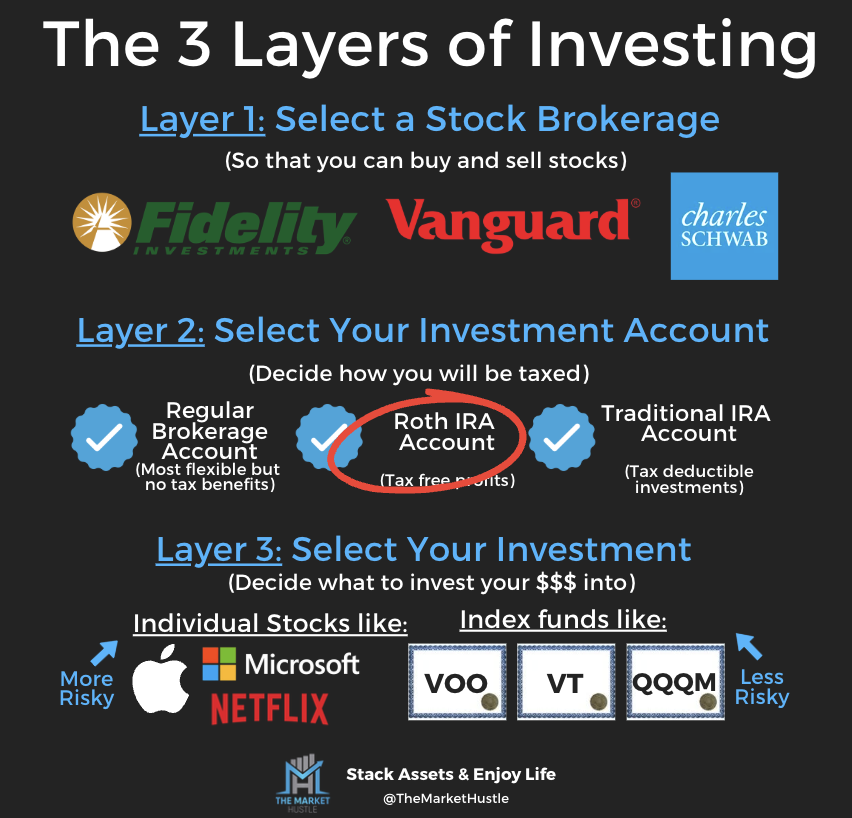
If you transfer $7,500 and do nothing else, your money sits in a "Settlement Fund" or “Money Market Fund” (this is just a fancy word for cash).
Check your account right now. If you see tickers like:
Money Market Fund
VMFXX
SPAXX
FDRXX

You are NOT invested. Your money is sitting in cash.
If you leave $7,500 in a cash fund earning 3% a year for 30 years, it might turn into about $18,000.
But if you invest that same $7,500 in a diversified index fund and let it compound?
It could turn into about $75,000, assuming an 8% average annual return.
That one click could be a difference of more than $55,000.
Log into your Roth IRA and check what you actually own.
If you've only deposited cash, you may still need to purchase investments.
Mistake #2: Overcomplicating what you invest in
You don't need to become a day trader or the next Warren Buffett stock picker to get rich from the stock market.
The simplest way to build wealth without turning the stock market into another job is to stick with diversified investment funds like S&P 500 ETFs.
For example, VOO, SPYM, and IVV are ETFs that track the S&P 500. Instead of picking individual stocks, you get exposure to roughly 500 of the largest publicly traded U.S. companies through one investment.
These funds are designed to spread your money across about 500 of the largest U.S. companies without you having to predict which ones will do well or not.
The index is also reviewed every quarter, and companies that no longer meet its rules get replaced, all without you having to do a thing.
A Roth IRA is also one of the few accounts where your money can grow tax-free.
If you gamble the money in individual stocks or stock options and lose the money, you can wipe out money that could've grown tax-free long-term.
You don't get to top off the account again if the money you add goes to zero.
The more boring you can keep your Roth IRA account, the better.
Mistake #3: Not automating your monthly investments
The best investors treat investing like their most important bill.
Because they know it's the only one that will pay them back.
It's easy to feel motivated to invest in the beginning of your investing journey.
But James Clear said it perfectly: "You do not rise to the level of your goals. You fall to the level of your systems."
By setting up automation, you take motivation out of the equation. It happens every time you get paid without you even having to think about it.
Just make sure you're automating both the money going into your account and the actual investments being purchased.
The goal is to build a system that consistently invests money for your future without requiring you to make the same decision every month. That’s what Money Mastery helps you build.
Mistake #4: Thinking you can't touch your Roth IRA until retirement
Many people believe that once money enters a retirement account, it's locked away until they're 59½.
But that's not true.
The Roth IRA account offers a unique advantage:
The money you personally added can be taken out at any time, tax-free and penalty-free.
The only things "locked" into this account are the profits and earnings your investments make.
To access the investment growth, you need to be at least 59½ and have the account open for 5 years to withdraw it tax-free.
For example, if you added $30,000 over the next 5 years and your investments grew to $50,000, you could withdraw your original $30,000 without taxes or penalties.
Mistake #5: Thinking you can share a Roth IRA with your partner
There are no joint Roth IRA accounts.
Roth IRAs are individual accounts, even if you're married.
You and your partner can each have your own Roth IRA (even if only one of you works) as long as you file taxes jointly and meet the contribution requirements.
Let's say you're married and only one of you works. You could still be able to contribute $7,500 to your own Roth IRA and another $7,500 to your spouse's Roth IRA.
That's $15,000 your household can invest across two accounts in 2026, assuming you're both under 50 and meet the requirements.
For 2026, married couples filing jointly can contribute the full amount if their combined modified adjusted gross income is below $242,000.
Mistake #6: Not realizing the Roth IRA limit also applies to your Traditional IRA
The $7,500 limit is shared across all Roth IRA + Traditional IRA accounts.
It is NOT $7,500 for your Roth IRA & $7,500 for your Traditional IRA.
You can technically have both accounts and add money to both accounts. But you have to be mindful of the total contribution limit each year.
For example, if you put $4,000 in a Traditional IRA, you only have $3,500 left for the Roth IRA.
If you go over the limit, the IRS slaps you with a 6% penalty every single year until you fix it.
Your 401(k) has its own separate contribution limit. This $7,500 limit applies to your combined Traditional and Roth IRAs.
Mistake #7: Assuming you make too much money to use a Roth IRA
Once your income passes $153k (single) or $242k (married), the IRS says you are "banned" from fully contributing directly.
The Loophole: You aren't banned from having a Roth. You're just banned from using the front door.
High earners use the "Backdoor Roth" strategy to get around the income limits:
Here's how it works (simplified):
Watch out for the pro-rata rule first (more on that below).
Contribute to a Traditional IRA.
Convert it to a Roth immediately.
Invest the money in your Roth.
File Form 8606.
Repeat every year you’re above the income limit.
Here's the catch: If you already have money in a Traditional or Rollover IRA that hasn't been taxed, converting money into your Roth IRA could create an unexpected tax bill.
This is called the pro-rata rule. If you already have other IRAs, talk to a CPA before using this strategy.
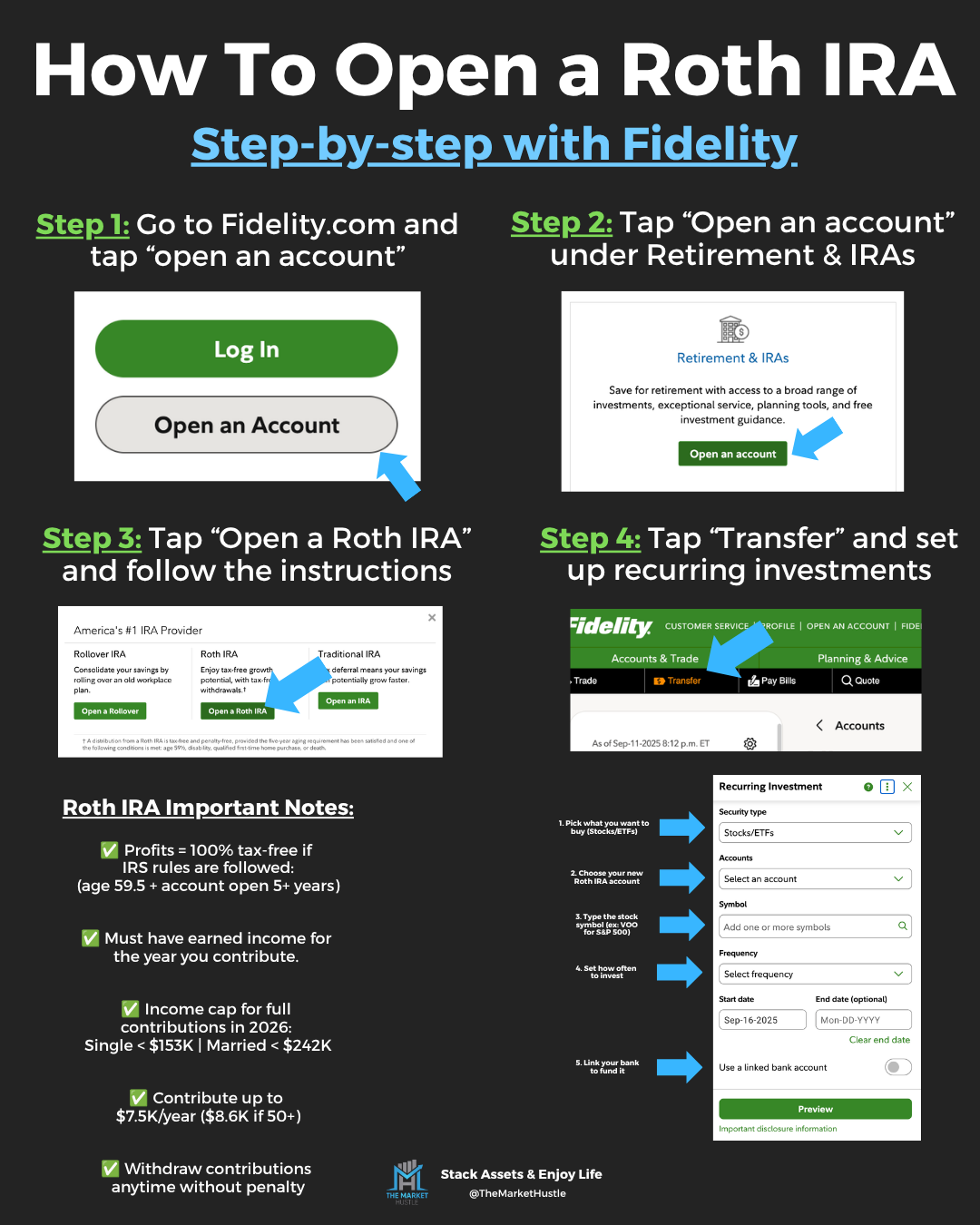
How to open this account (using Fidelity as an example, not affiliated):
Go to Fidelity.com and click "Open an Account" in the top menu.
Select "Retirement & IRA" and then "Roth IRA" (Make sure you don’t click "Rollover IRA" or "Traditional IRA").
Complete the identity verification (Social Security #, Employment Info).
Fund the Account: Link your checking account and transfer money.
IMPORTANT STEP: Once the money settles, use the "Trade" button to buy your investment. Do not skip this.
Once your first investment is purchased, set up automatic investments so you're consistently investing without having to remember each month.
Is opening a Roth IRA worth it?
A Roth IRA is one of the most powerful accounts available for building long-term wealth.
And now you understand how to use one, what mistakes to avoid, and how to get started.
But here's something important I want you to understand:
Knowing how to use a Roth IRA is only one piece of building wealth.
You still need to figure out how much you can afford to invest, which accounts to prioritize, what investments to buy, and how everything fits together with the rest of your finances.
That's exactly why I created Money Mastery.
It's my step-by-step program designed to help you build your own automated financial system.
One that helps you understand where your money goes, how much to save and invest, which accounts and investments to use, and how to eventually turn those investments into financial freedom.
The goal isn't to spend your life managing money. It's to build a system that makes managing money simple.
And right now, the self-guided tier of Money Mastery is 33% off until Sunday, November 15 at 11:59pm PT.
If you're ready to stop piecing together random financial advice and start building a system you understand and can actually follow, I'd love to help you get started.
Get 33% off Money Mastery before Sunday, November 15th.
